The first question travellers ask us at the airport, in the car, over WhatsApp, is always the same: "What will the weather be like?" After a decade of driving the Marrakech road we can promise you one thing about Essaouira's weather — it will not be what you expect from the rest of Morocco.
While Marrakech swelters past 40°C in July and the desert bakes, Essaouira rarely pushes past 26°C. While inland cities shiver at night in January, this port town stays mild. The secret is the wind and the water: a constant Atlantic breeze called the alizé and the cold Canary Current that flows past the coast. Together they give Essaouira one of the most comfortable climates in the country, every single month of the year.
This guide breaks down the weather in Essaouira month by month — temperatures, rain, wind and that famous morning fog — so you can pick the perfect time for your trip. Most visitors arrive from Marrakech, and the 2.5-hour drive is easy with a private taxi from Marrakech to Essaouira, whatever the season.
Why Essaouira's Climate Is Unique
Essaouira sits on the Atlantic coast of Morocco at roughly 31°N, directly in the path of the trade winds. Two forces shape everything. The first is the Canary Current, a cool current running south along the African coast that keeps sea temperatures at a refreshing 17–22°C and, in spring and early summer, drags up deeper, colder water to the surface. The second is the alizé, the prevailing north-westerly wind that reaches the coast almost every afternoon from May to September.
The result is a climate that feels like a mild, extended spring. Summer afternoons hover around 24–27°C with a strong breeze that makes the beach comfortable rather than scorching. Winters are soft and rainy only in short bursts. Humidity is moderate, and nights stay pleasant because the sea releases heat slowly. Compare that with Marrakech, two and a half hours inland, where summer nights can stay above 30°C, and you understand why so many Moroccan families come here to escape the heat. There is a practical rhythm to this climate you will feel within a day. Expect the wind to strengthen around midday, peak in the late afternoon and drop again at dusk; the beach is at its most peaceful in the morning and evening, while the breezy midday is when the kites fill the sky and the terraces fill with people hiding from the sun. Dress for a change at 2pm — one light layer over a t-shirt — and you will always be comfortable.
One quirk you should know about: on summer mornings the medina is often wrapped in low sea fog. Locals call it the "white veil", and it usually burns off by mid-morning, leaving a perfect blue-sky afternoon. Do not let an overcast breakfast fool you into packing for a cold day.
Local tip: The forecast for Essaouira changes by the hour, not by the day. Pack layers and plan outdoor activities for the afternoon — mornings are often misty, then the sun and wind take over.
Month-by-Month Weather in Essaouira
Here is the honest, street-level picture for every month of the year. These are long-term averages, but they are close to what you will actually feel on the ground.
| Month | Avg High | Avg Low | Rain | Character |
|---|---|---|---|---|
| January | 19°C | 11°C | 8 days | Cool, sunny, quiet |
| February | 20°C | 12°C | 7 days | Mild, few showers |
| March | 21°C | 13°C | 6 days | Fresh, windy |
| April | 21°C | 14°C | 4 days | Settled, lovely |
| May | 22°C | 15°C | 2 days | Warm days, wind building |
| June | 23°C | 17°C | 0–1 days | Windy, bright, dry |
| July | 25°C | 18°C | 0 days | Peak wind, perfect surf |
| August | 26°C | 19°C | 0 days | Hottest month, busy |
| September | 26°C | 18°C | 1 day | Warm, wind easing |
| October | 24°C | 16°C | 3 days | Golden, calm, ideal |
| November | 21°C | 14°C | 6 days | Mild, quiet season starts |
| December | 20°C | 12°C | 8 days | Wettest month, still mild |
Winter (December–February) is the coolest, rainiest and quietest season, yet highs still reach 19–20°C most days. Rain comes in short, sharp showers rather than endless drizzle, and the town's famous sunshine re-appears within the hour. It is a lovely time for the medina, the galleries and long lunches — and the best value of the year.
Spring (March–May) is when the alizé starts to pick up and the days lengthen. Temperatures climb slowly, foggy mornings become common, and the coastal vegetation erupts in green. By May the beach is warm enough to swim in a wetsuit, and the surf schools fill with their first students of the year.
Summer (June–August) is the busiest and windiest season. The breeze is what makes Essaouira liveable — it turns a 25°C day into a delight and keeps the terrace restaurants full until late. This is prime season for windsurfing and kitesurfing, and the harbour side is buzzing every evening. Book accommodation well ahead.
Autumn (September–November) is the connoisseur's choice. The wind drops, the sea stays warm, the crowds thin out and the light turns golden. October is, in our honest opinion, the single best month of the year for weather in Essaouira.
Wind, Rain & the Atlantic Breeze
Wind is the defining feature of Essaouira — the town's name itself is linked to the trade wind, and the constant breeze is why it became one of the world's great windsurfing and kitesurfing destinations. From May to August the afternoon alizé routinely reaches 30–40 km/h, which is exactly what board riders want. If you plan to kite or windsurf, July is unbeatable; the bay is dotted with colourful kites and the schools run full courses.
If you prefer calm seas and still air for swimming or family time on the sand, aim for April, September or October, when the breeze is gentle and the water is at its most pleasant. And keep the wind in mind for the famous beach umbrella: a cheap windbreak from the souks is worth its weight in gold in summer.
Rain follows a simple pattern — almost all of it falls between November and February, peaking in December. Annual rainfall is only around 300–400 mm, much less than northern Morocco. The long, dry stretch from May to October means you can plan an entire summer itinerary without a single rainy day.
Two subtler weather features matter as much as the forecast. The first is humidity: the coast hovers around 65–80% all year, which makes the air feel softer than inland but also means clothes dry slowly in winter. The second is the sea fog — from May to August it sometimes rolls in on mornings and lifts by mid-morning. Locals simply plan around it, and you should too: the misty morning is a lovely time for the souks and the galleries, and the sunny afternoon for the beach.
Sea temperature follows its own rhythm. The ocean is at its coldest, around 17°C, in early summer, when the cold upwelling peaks, and at its warmest, around 21–22°C, in October and November. For swimming, autumn is genuinely better than July, which surprises almost every visitor. For surf lessons, the spring swell plus a good wetsuit makes April through June the most rewarding window.
The Best Time to Visit Essaouira
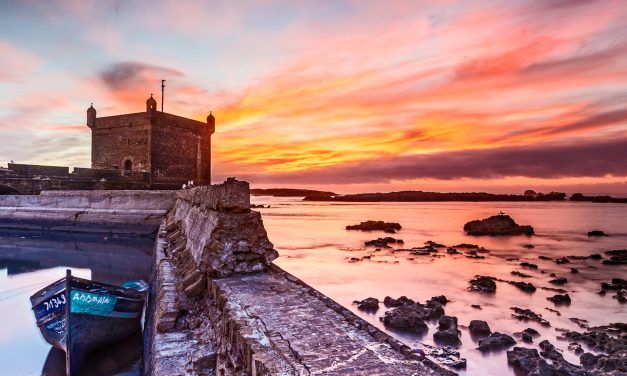
There is no bad month, only different Essaouiras. For the best overall weather — warm days, mild nights, minimal wind and almost no rain — the shoulder seasons of April–June and September–October win. You get comfortable temperatures in the low-to-mid 20s, plenty of sunshine, thinner crowds than July and August, and reasonable prices. If you like to plan around the calendar, the town gives you extra reasons to choose a season. The Gnawa World Music Festival fills the ramparts with free concerts in late June, the Andalusian Music Festival brightens October, and February's almond blossom paints the inland routes pink for a long weekend. Winter brings the Skala ramparts at their most photogenic, when the low sun and quiet lanes make the medina feel like a private city.
Families with school-age children often travel in July and August, when the beach and the water are at their most inviting, despite the wind and the crowds. Winter travellers get the opposite bargain: empty lanes, cosy riad fireplaces, cultural events and the famous winter sun that keeps the golf courses and beach walks open. Whenever you decide to go, a car with a driver makes it simple — our taxi from Essaouira to Marrakech and airport transfers run 365 days a year, rain or shine.
Local tip: If you are chasing warm beach weather, come in October, not July. The water is actually warmer in autumn than in summer, because the summer upwelling of cold deep water cools the sea in June and July.
What to Pack & How to Get Here
The single best packing advice for Essaouira is layers. The daily swing between morning mist, windy midday and a cool evening can be 8–10°C. A light windbreaker or fleece is useful every month except July and August, and a warm layer is essential for winter evenings.
- Lightweight cotton and linen clothes — comfortable in the heat, quick to dry.
- A windproof jacket or softshell — your best friend on the beach and the ramparts.
- Sunscreen and a hat — the breeze hides the strength of the sun; people burn without feeling it.
- Swimwear and a towel — the bay is swimmable from June to November.
- Comfortable walking shoes for the medina's cobbles and the long beach promenade.
- A small day-bag and refillable water bottle — tap water is fine, but bottled is everywhere.
Getting to Essaouira is simple in any weather. The easiest option is flying into Mogador Airport (ESU), a 20-minute drive from the medina, and taking an airport transfer with a fixed price from 15€. From Marrakech, a private taxi covers the 175 km in about two and a half hours through the argan forests — a drive that is pleasant even in winter drizzle, with a driver who knows the road's every curve.
Whatever month you pick, the weather in Essaouira is gentle enough to let the town do its magic: the blue boats, the white walls, the wind and the sea. Check the forecast, pack a jacket, and come.
Ready to travel? Book a private driver in Essaouira or an Essaouira airport transfer and enjoy door-to-door comfort with a professional local driver, whatever the season.